
Re-Stack
From: wisewolfmedia.substack.com

Daniel’s Note To Readers: Most of the content in the following article is beyond my intellectual grasp, but I’m glad I read it in its entirety, and I hope you do, too. The author is stating publicly that which was once dangerous to publish within the scientific community: the idea of Intelligent Design and the logical necessity of a Creator of all things seen and unseen. There was a time when having any aversion to, or merely questioning, the theory of evolution by a scientist would lead to the drying-up and eventual evaporation of research dollars, along with his/her professional credibility. But things have changed. Discoveries in quantum physics/mechanics have slowly and persistently led to unavoidable mathematical conclusions pointing toward the existence of a highly intelligent creator whose finger prints are all over that which exists in nature. I suggest that you read the essay to its end. You may not understand its fine points related to the perplexities of advanced science and mathematic theorem, but the author is speaking to the general public, aware of our limited knowledge, and argues for logical conclusions using language we can all understand. Daniel (Murphy) Kennedy
The Mathematics of Creation: What Happens When Gödel, Einstein, and Quantum Mechanics All Point to God
What happens when string theory, quantum mechanics, and pure logic all point to the same impossible conclusion?
Oct 15, 2025
Editor’s Note
I was raised Catholic, lost my faith completely in my twenties, and spent years as a committed materialist who believed the universe was nothing more than particles bouncing around according to blind physical laws. Then I started studying quantum physics seriously. The more I learned about quantum mechanics, string theory, and the mathematical structures underlying reality, the more questions I had about whether a purely materialist worldview could actually explain what we observe. I gave up my atheistic certainty and became agnostic because I simply didn’t have enough data to claim God definitively didn’t exist. That agnosticism launched me into years of deep study across quantum physics, advanced mathematics, computer science, occult philosophy, and religious scripture. After all that research, I’m now absolutely certain there is a God, and this article presents some of the most compelling evidence I discovered on that journey. If you’re an atheist reading this and your plan is to comment “God isn’t real because I said so” without presenting any actual evidence or engaging with the physics, save your energy. Nobody cares about unsupported assertions. But if you want to genuinely debate the evidence presented here and you have actual counterarguments or data that refutes the existence of God, I’m extremely interested in what you have to say.
The universe speaks mathematics. Not poetry, not metaphor. Actual theorems and equations that describe reality with surgical precision. Eugene Wigner called it “the unreasonable effectiveness of mathematics” in 1960, and nobody’s answered his question yet. Why should abstract symbols scratched on paper by evolved primates predict the behavior of galaxies?
It gets weirder. We’ve now discovered that reality uses the same error-correcting codes that Intel engineers invented to keep your laptop from melting down. The fabric of spacetime has backup systems. Redundancy protocols. Recovery algorithms.
Someone, or something, anticipated problems and built in fixes before the problems could happen.
Meanwhile, string theory says we’re trapped in four dimensions while six or seven others curl up too small to see. Change how they curl and you get different physics. Different constants. Different universes. There are 10^500 ways to curl them. We live in one of the vanishingly few configurations where atoms don’t collapse and stars don’t explode.
The odds of that happening by accident? One in 10^500.
That’s not a big number. That’s not a number at all. It’s a cosmic obscenity. Write a zero on every atom in the observable universe and you’d run out of atoms before you finished writing it.
Something designed this. Or we need to believe in 10^500 unobservable parallel universes. Pick your metaphysics.
Let’s go deeper.
Part 1: The Invisible Architecture
Your Universe Runs on Extra Dimensions You Can’t See
Einstein united space and time into spacetime. Four dimensions total. Three of space, one of time. We live there, or we think we do.
String theory requires more. Ten dimensions at minimum, maybe eleven. Why? Because when physicists tried to marry quantum mechanics to gravity, the math puked up infinities. Meaningless garbage. Division by zero everywhere.
Then someone had an idea. What if particles aren’t points but tiny vibrating strings? The math cleaned up. The infinities vanished. But only if the strings vibrate in ten or eleven dimensions.
You don’t see these extra dimensions because they’re compactified. Rolled up tight. Imagine a garden hose from across a field. Looks one-dimensional. Get close and you see the cylinder. The extra dimensions are like that, except they’re curled down to 10^-35 meters. Smaller than anything we can measure.
The shape of these curled dimensions determines everything. What particles exist. How strong gravity is. Whether chemistry works. They’re called Calabi-Yau manifolds, and they’re fantastically complicated six-dimensional pretzels of curved space.
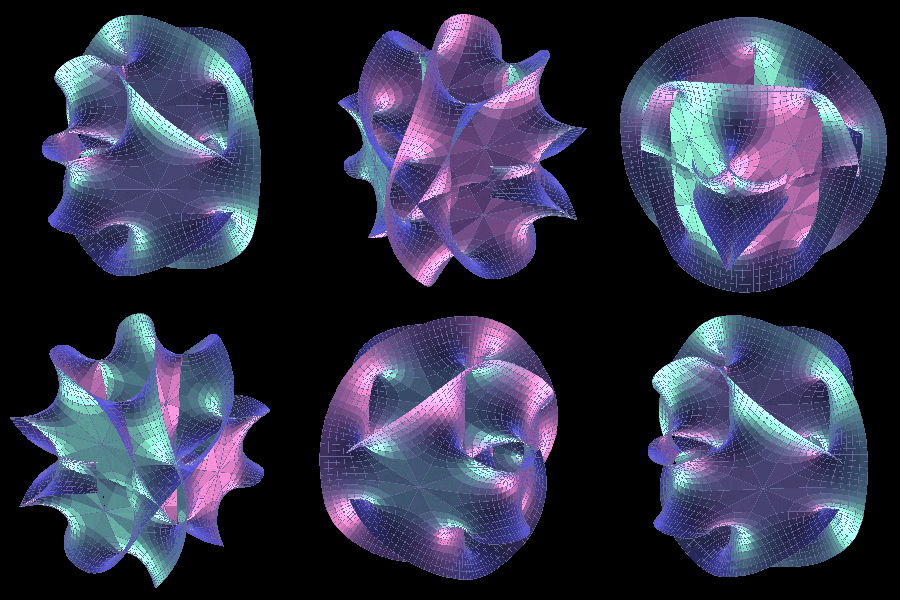
Here’s what keeps physicists awake at night. There are approximately 10^500 different ways to curl up the extra dimensions.
Each one produces a different universe with different laws! Let that sink in.
The Landscape of Infinite Possibilities
Leonard Susskind calls it “the landscape.” Picture a terrain with 10^500 valleys. Each valley is a possible universe. Most valleys are dead. No atoms. No stars. Just radiation or black holes or empty void.
A few valleys permit chemistry. Fewer still allow stars to burn long enough for planets to form. Only a microscopic fraction support life.
We live in one of those rare valleys. Why?
The multiverse people say all 10^500 universes exist. We’re in this one because we couldn’t exist in the others. Anthropic selection. Like asking why you were born in a hospital instead of on Mars. You weren’t. But some baby somewhere was born in every hospital, and you’re the one asking the question from this particular hospital.
Sounds reasonable until you think about it. The multiverse hypothesis requires either infinite time, infinite space, or eternal inflation to generate 10^500 separate universes. Where’d the infinite resources come from? And why does the mathematical structure of string theory produce exactly the kind of landscape that contains life-permitting valleys at all?
A different fundamental theory might produce only dead universes. Every valley poisonous. But string theory’s landscape has oases. Why?
Professor and author Paul Davies nailed it. “The multiverse is a cosmic lottery. But who bought the ticket?”
M-Theory: When Five Theories Become One
In the 1990s, string theory had a problem. There were five different versions. Each mathematically consistent. Each making different predictions. Which one described our universe?
Then Ed Witten showed that all five theories are different perspectives on one eleven-dimensional reality. Like how a cube looks different from different angles but it’s still one cube. This unified framework is called M-theory.
This matters philosophically. If our universe is a brane, then time itself is a local property of our brane. Not fundamental. The bulk might be timeless. We’ll come back to this when we talk about what existed “before” the Big Bang.
The mathematical structure of M-theory is absurdly fragile. Change almost anything and the whole edifice collapses into inconsistency. The theory doesn’t just require fine-tuned constants. It requires fine-tuned laws. The rules themselves had to be exactly right for consistent physics to exist.
It’s like discovering that for a watch to work, not only do the gears need precise dimensions, but the fundamental properties of metal and friction must be calibrated to exactly the right values for gears to be possible at all.
Part 2: Reality Has Backup Systems
The Revolution Nobody Noticed
In 2014 and 2015, a group of physicists published papers in the Journal of High Energy Physics that should’ve made headlines. Ahmed Almheiri, Xi Dong, Daniel Harlow, John Preskill. They were studying the AdS/CFT correspondence, a relationship between theories of quantum gravity and quantum field theories.
They discovered that spacetime uses error-correcting codes.
Not kinda sorta uses them. Not metaphorically. Literally the same mathematical structures that engineers use to protect data from corruption.
Let me explain why this matters. But first, you need to understand what error correction is.
How to Protect Information from the Universe’s Noise
Your laptop has error-correcting codes in its RAM. Cosmic rays hit memory chips. Bits flip from 0 to 1 or vice versa. Without correction, your computer would crash constantly.
The solution is redundancy with structure. Don’t just duplicate bits. Encode them mathematically so you can detect and fix errors. The Hamming code, invented in the 1950s, takes four data bits and adds three parity bits. If any single bit flips, you can figure out which one and fix it.
Quantum error correction is harder. A quantum bit (qubit) exists in superposition. It’s both 0 and 1 simultaneously until you measure it. You can’t copy it (the no-cloning theorem forbids copying quantum states). And any interaction with the environment destroys the superposition through decoherence.
Quantum engineers solved this with entanglement. Encode one logical qubit across multiple physical qubits in a specific pattern. Peter Shor’s code uses nine physical qubits to protect one logical qubit. Even if several qubits get corrupted, you can recover the original information.
The math involves stabilizer generators and syndrome measurements. Technical stuff. The key point is this: quantum error correction requires sophisticated structure. Entangled states arranged precisely. Recovery algorithms. It doesn’t happen by accident.
Spacetime Is an Error-Correcting Code
Now we get to AdS/CFT, discovered by Juan Maldacena in 1997. It’s a correspondence between two theories:
A theory of quantum gravity in some region of space (the “bulk”)
A quantum field theory on the boundary of that region (one dimension lower)
It’s holographic. All the information about what happens in three dimensions is encoded on a two-dimensional surface. Like how a hologram on flat film contains a 3D image.
What Almheiri and colleagues proved is that the mathematical structure of this correspondence is identical to quantum error-correcting codes.
Specifically:
Bulk information (actual spacetime) = logical qubits
Boundary information (holographic projection) = physical qubits
The correspondence itself = an error-correcting code
You can erase up to half the boundary and perfectly reconstruct what’s happening in the bulk. This is exactly what error-correcting codes do.
The mathematics is explicit. The encoding map 𝔼 takes bulk states to boundary states. The recovery map ℛ reconstructs bulk information from corrupted boundary data. Even after erasure ℰ, you get back what you started with:
ℛ ∘ 𝔼 ∘ ℰ ≈ 𝔼
The stabilizer matrix H enforces constraints: H|ψ⟩ = 0 for all valid code states. It’s the same formalism used in quantum computers.
The Engineering Signature
Here’s what you need to understand. Every error-correcting code ever discovered by humans was designed intentionally.
Reed-Solomon codes in CDs. Hamming codes in RAM. LDPC codes in cell phones. Convolutional codes in satellites. Turbo codes in 4G networks. All products of intelligent engineering.
Error-correcting codes don’t arise from random processes because they require:
Foresight: anticipating errors before they happen
Structured redundancy: mathematically precise, not just duplication
Recovery algorithms: knowing how to extract original data from corrupted data
When NASA designed error correction for Voyager 1, engineers weren’t responding to errors they’d seen. They were predicting the hostile environment of deep space. Building in protection beforehand.
Voyager launched in 1977. It’s still sending data. The codes work.
Now consider this. The fundamental architecture of spacetime, revealed through our best theories of quantum gravity, contains error-correcting codes.
If you found a laptop in the forest, you wouldn’t think it assembled itself. The error-correcting codes in its memory would be particularly strong evidence of design.
The universe is that laptop. We just discovered its memory has error correction.
The standard athiest or materialist response is “it just happens to work that way.”
Would you accept that answer for a computer?
Part 3: When Logic Points Beyond Itself
What Gödel Actually Broke
In 1931, Kurt Gödel published a paper that destroyed the foundations of mathematics. Or at least what mathematicians thought were the foundations.
The dream was to reduce all mathematics to a complete formal system. Start with axioms. Derive everything else through pure logic. Build math like building a machine. No ambiguity. No gaps.

Gödel proved this is impossible.
His first incompleteness theorem says any consistent formal system powerful enough to express arithmetic contains true statements that can’t be proven within the system.
Read that again. There are mathematical facts that are objectively true but unprovable using only the axioms of the system.
His second theorem is worse. No consistent formal system can prove its own consistency.
Think of it like this. Imagine a legal system that tries to be complete. Every situation has a law. Every verdict can be derived from basic principles. Gödel proved this can’t work. Any sufficiently rich legal system will have cases where a statement is true but unprovable using only the laws.
Truth Lives Outside the Box
The implications stagger. Truth transcends proof. Mathematical facts exist independent of any formal system we write down.
This means math isn’t invented. It’s discovered. We’re exploring a landscape that exists whether we think about it or not.
Gödel himself drew the connection to consciousness. Human mathematicians can recognize truths that no algorithmic formal system can prove. This suggests the human mind transcends mechanical computation. We’re not Turing machines with delusions of grandeur.
And if mathematical truth exists independent of formal systems, something must ground that truth. Many philosophers argue that “something” is a divine intellect. A mind that contains all mathematical truth.
As Gödel wrote, “I don’t believe in empirical reality as the ultimate reality. Behind the empirical world, as it appears to us, there is a totally different reality of which the empirical world is a kind of projection.”
The Ontological Proof Nobody Taught You
Later in life, Gödel developed a separate argument. A formalization of Anselm’s medieval proof for God using modal logic.
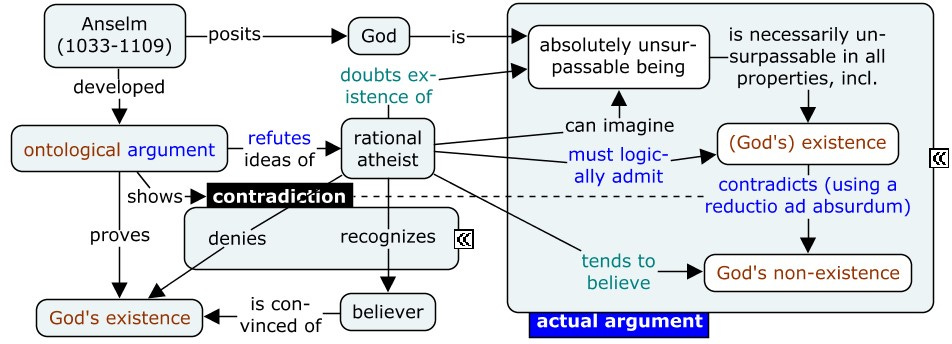
It’s rigorous. Published posthumously in his collected works. Most people have never heard of it.
Here’s the structure in plain language.
Define “positive property” as a property it’s better to have than not. Wisdom. Power. Goodness. Call a being “God-like” if it has all positive properties.
Axiom 1: If a property is positive, its negation isn’t.
Axiom 2: Any property entailed by a positive property is positive.
Axiom 3: Being God-like is positive.
Axiom 4: If a property is positive, it’s necessarily positive in all possible worlds.
Axiom 5: Necessary existence is a positive property.
Conclusion: If it’s possible for a God-like being to exist, then a God-like being necessarily exists in all possible worlds, including ours.
The logical structure is:
◊∃x G(x) → □∃x G(x)
If possibly God exists, then necessarily God exists.
Why does this work? If God is defined as having all positive properties including necessary existence, then either God exists in all possible worlds or God exists in no possible worlds. There’s no middle ground.
Since we can coherently conceive of God, God is possible. If possible, God is necessary. If necessary, God exists.
Subscribe
Is this sound? The key question is whether “necessary existence” is truly a positive property. Critics build parody arguments to show the logic proves too much. Defenders say the axioms capture genuine intuitions about perfection.
Gödel wasn’t claiming mathematical proof. He was showing that given reasonable premises about perfection and possibility, God’s existence follows logically.
Part 4: The Universe’s Impossible Birth
The Boltzmann Brain Problem
Ludwig Boltzmann proposed a thought experiment in the 1890s. Imagine an infinite universe with random thermal fluctuations. Eventually, atoms will randomly arrange into any configuration. Including a functioning brain with false memories.
The probability of any specific configuration is low. But give it infinite time and probability becomes certainty.
Here’s the problem. If our universe is a product of random fluctuation, it’s vastly more probable that you’re a Boltzmann brain than a real person.
Why? Creating a single brain with false memories requires far less improbable fluctuation than creating an entire universe with 13.8 billion years of history, billions of galaxies, and consistent physical laws.
Run the numbers. In a randomly fluctuating universe, for every real observer there should be 10^(10^50) Boltzmann brains with identical experiences but fake pasts.
You should wake up as a disembodied consciousness floating in void with false memories of having a body and reading an article. That would be the overwhelmingly likely outcome.
The fact that you’re not a Boltzmann brain is strong evidence that the universe isn’t a random fluctuation. The low-entropy initial state was real. It was set deliberately.
The Entropy Catastrophe
The Second Law of Thermodynamics says entropy always increases. Disorder spreads. Things fall apart. You can scramble eggs but you can’t unscramble them.
Yet the Big Bang created a universe in an extraordinarily low-entropy state. Perfectly smooth. Uniform. Ordered.
Roger Penrose calculated the probability of this happening by chance: 1 in 10^(10^123).
This isn’t a big number. This is an obscenity written in mathematics. If you wrote one zero per atom across the entire observable universe, you’d run out of atoms before finishing the number.
It’s not just unlikely. It’s effectively impossible without something setting those initial conditions.
Inflation Doesn’t Save You
Cosmologists invoke inflation to explain uniformity. In the first 10^-32 seconds, space expanded exponentially. This smoothed out irregularities and explains why the universe looks the same in all directions.
But inflation has its own fine-tuning problems:
The inflaton field needs exactly the right potential energy curve
The initial patch that inflated must already be larger than 10^-26 centimeters
The exit from inflation must be precisely timed
Quantum fluctuations during inflation must have exactly the right amplitude
Inflation doesn’t solve fine-tuning. It pushes it back one level. Paul Steinhardt, one of inflation’s developers, later said, “We thought inflation would explain the Big Bang. Instead it created more problems than it solved.”
You still need to explain where the inflaton field came from, why it had the right properties, and what set the initial patch in motion.
Part 5: Time, Causation, and the Ultimate Dodge
The “Something from Nothing” Con
Lawrence Krauss wrote a book called A Universe from Nothing. His argument: quantum mechanics allows particles to pop into existence from vacuum. Therefore the universe can create itself.
This is bullshit. Let me explain why.
The quantum vacuum isn’t philosophical “nothing.” It’s a seething ocean of quantum fields with properties and laws. Virtual particles borrow energy from the vacuum and pay it back. But the vacuum itself has structure. It obeys equations. It has energy states.
That’s not nothing. That’s something.
Moreover, quantum fluctuations happen in time. But at the Big Bang, time itself began. You can’t have fluctuations without time. The vacuum, the fields, and time all need explaining.
The question “Why is there something rather than nothing?” remains untouched by quantum mechanics. Physics assumes laws, fields, and time already exist. It doesn’t explain their origin.
God Outside the Game Board
Here’s where string theory becomes philosophically crucial.
If our universe is a four-dimensional brane in an eleven-dimensional bulk, then time is a local property of our brane. Not fundamental to reality.
This resolves the “Who created God?” objection.
The traditional problem:
If God created the universe, who created God? If God needs no creator, why can’t the universe need no creator?
The higher-dimensional solution:
Time is a property of our universe, not of ultimate reality. God exists in the timeless bulk, not within the temporal brane. The question “What came before God?” is meaningless, like asking “What’s north of the North Pole?”
Creation applies only to temporal entities within time. Not to the ground of being itself.
In modal logic, God would be a necessary being. One that exists in all possible worlds because its non-existence is logically impossible. The universe is contingent. It could have failed to exist or existed differently.
Can Time Be Cyclic?
Some cosmologists propose cyclic universes. Big Bang, expansion, contraction, Big Crunch, new Big Bang. Eternally.
Roger Penrose’s Conformal Cyclic Cosmology says the far future of one universe (maximum entropy, all particles decayed) becomes mathematically identical to the Big Bang of the next. Time is cyclic without beginning or end.
The Steinhardt-Turok model has branes colliding periodically in the higher-dimensional bulk. Each collision produces a Big Bang. No first collision. Just cycles.
Does this eliminate God? Not necessarily.
Even eternal cycles raise questions. Why does the cycle exist rather than not? Cyclic doesn’t mean self-explanatory. Why these laws rather than others? Why does the cycle produce life?
An eternal cycle could be how a timeless God sustains creation. Not a rival to theism but a description of method. Thomas Aquinas explicitly allowed for an eternal universe created by God. “Creation doesn’t mean a temporal beginning but a relationship of dependence.”
Part 6: The Probability Hammer
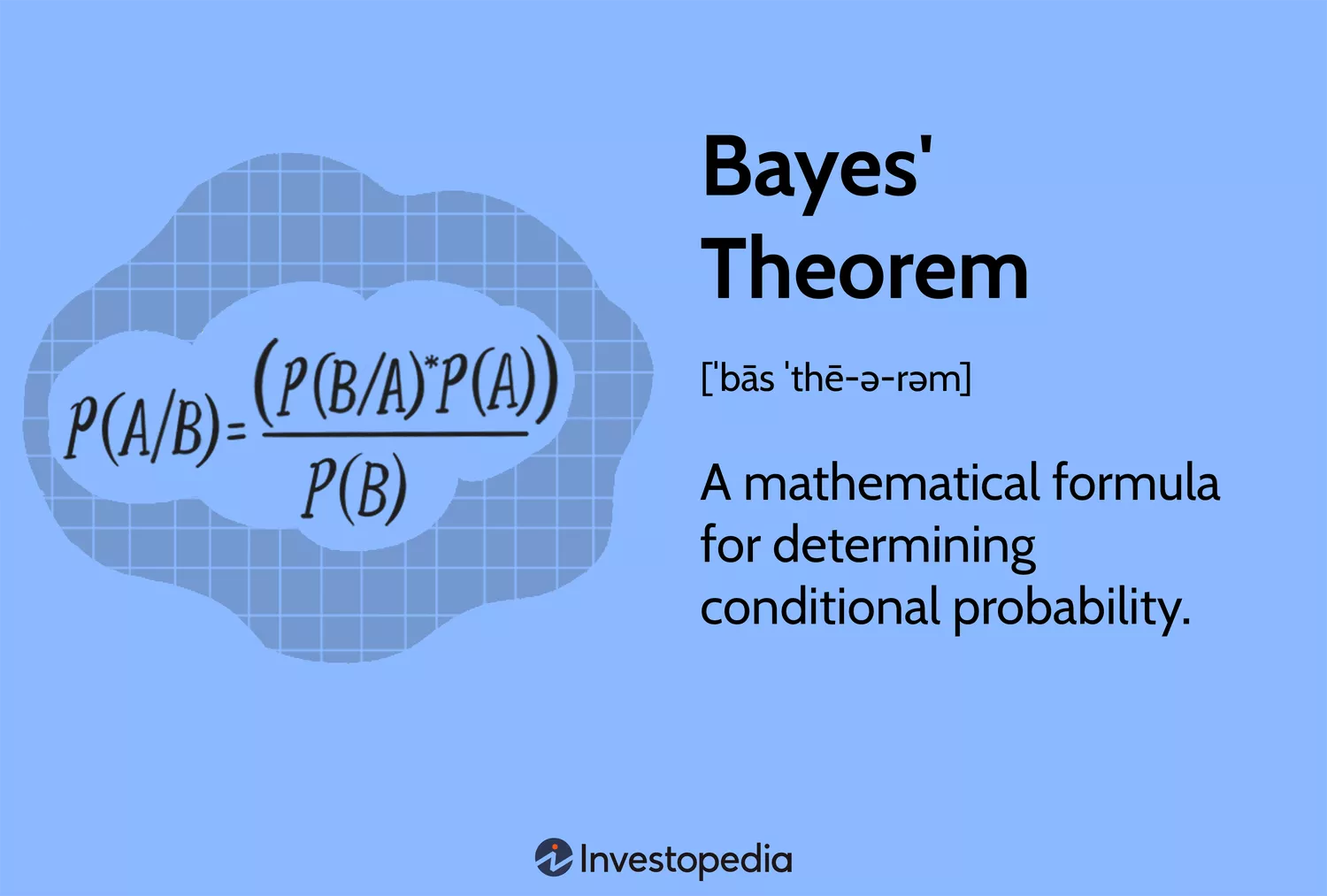
Bayes’ Theorem is just a fancy way of saying “how much should this evidence change my mind?” It’s what detectives use. What doctors use. What anyone uses when new facts come in.
Here’s the setup. Let’s say you’re a hardcore skeptic. You think there’s only a 1% chance the universe was designed. A 99% chance it’s all random accident.
Now look at the evidence. We’ve got error-correcting codes in spacetime. We’ve got fine-tuning to one part in 10^500.
Ask yourself: If the universe was designed, how likely is this evidence? Pretty damn likely. Like 90% likely. If an engineer built reality, of course it would have backup systems and precise calibration.
Now ask: If the universe is random chance, how likely is this evidence? Basically impossible. One in 10^500. That’s hitting the lottery every day for a trillion years while getting struck by lightning.
Here’s where the math gets brutal. Even though you started 99% sure it’s all random, the evidence is so lopsided that you have to flip your conclusion. The probability of design shoots up to nearly 100%.
Why? Because the evidence we see is exactly what we’d expect from design and absolutely nothing like what we’d expect from chance. The numbers aren’t even close. It’s like finding a murder weapon covered in fingerprints and DNA. Sure, maybe the defendant is innocent. But the evidence says otherwise.
That’s Bayes’ Theorem. Start skeptical. Look at evidence. Do the math. Change your mind.
The Cumulative Case
The power comes from independent lines of evidence converging:
String landscape: 10^500 universes, ours permits life
Quantum error correction: engineered codes in spacetime
Initial entropy: 10^(10^123) to 1 against chance
Fine-tuning: ~26 constants precisely calibrated
Gödel’s theorems: math points beyond formal systems
Boltzmann brains: random fluctuation ruled out
Higher dimensions: framework for transcendent causation
Each piece is consistent with design. Together they form a web that makes chance explanations absurd.
The Uncomfortable Conclusion
The universe reveals itself through mathematics. Not just any mathematics. Precisely the kind that looks engineered.
Error-correcting codes that anticipate damage and build in redundancy. Fine-tuning across multiple independent constants. A string landscape vast enough to contain life-permitting oases. Logical structures pointing beyond themselves. Low-entropy origins incompatible with accident. Higher-dimensional frameworks allowing transcendent causation.
This isn’t “God of the gaps.” It’s “God of the structures.” The universe exhibits specific architectural features that, in every other context, indicate intelligent design.
When you find a laptop in the forest, you don’t conclude it assembled itself. When you find error-correcting codes, you don’t assume random chance wrote them. When you find fine-tuning to one part in 10^500, you don’t shrug and invoke infinite invisible universes.
Science can’t prove God exists. But it’s revealed a cosmos that looks exactly like what we’d expect if a transcendent intelligence set the initial conditions, chose life-permitting laws from an infinite landscape, and embedded error correction into the deepest level of reality.
The conversation between physics and philosophy remains open. But the idea that science has rendered God obsolete is itself obsolete.
The more we understand the mathematical structure of reality, the more that structure looks like a signature.
You can ignore it. You can invent parallel universes to explain it away. Or you can follow the evidence where it leads.